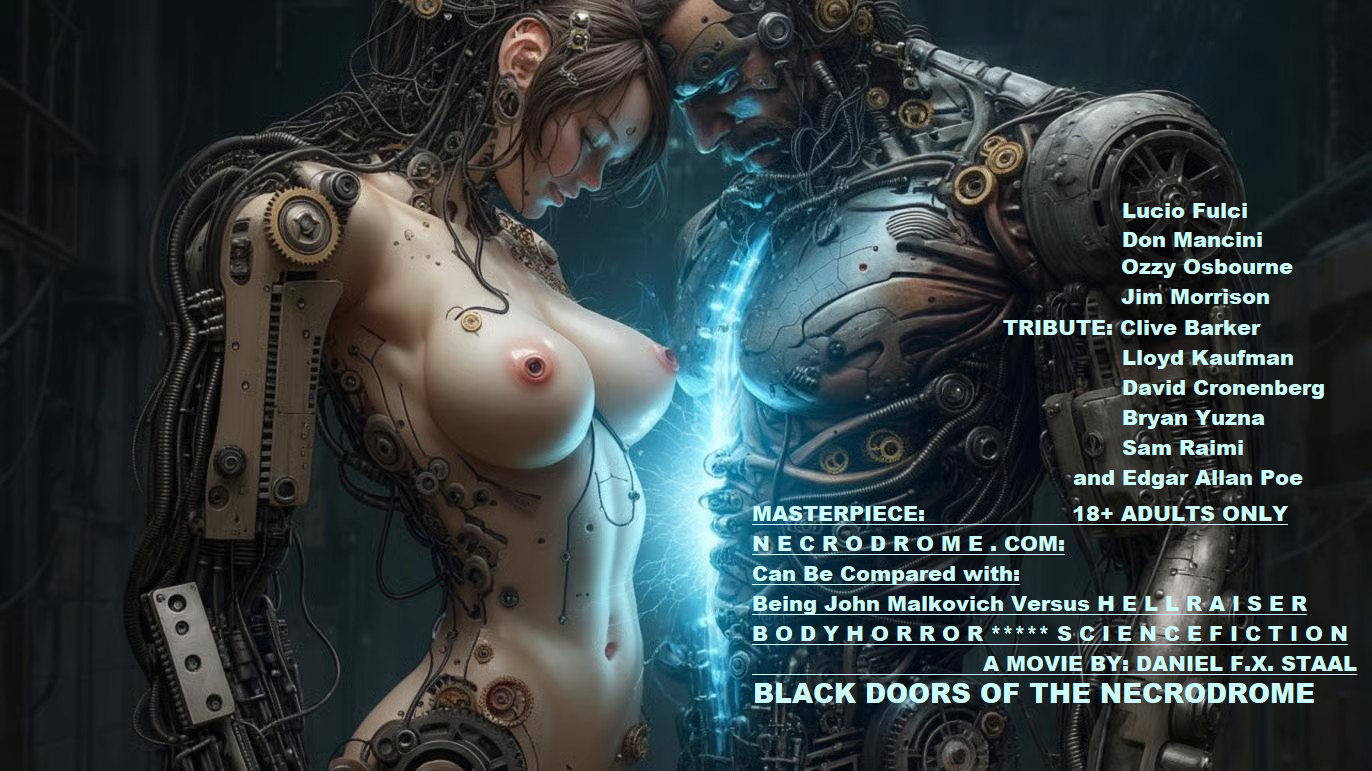
MASTERPIECE: NECRODROME.COM • 18+ ADULTS ONLY • A MOVIE BY DANIEL F.X. STAAL • BODYHORROR ***** SCIENCE FICTION
About Wood Cock Spock Rocks
Wood Cock Spock Rocks is an underground body-horror film, horror-comedy soundtrack project and surreal cult transmission by Daniel FX Staal.
The film is not meant as realism or autobiography. It is fantasy, satire, nightmare logic and deliberate underground provocation.
The characters, masks, grotesque images and absurd scenes are fictional devices. They exist to create a cult-film universe of body horror, dark humour, science fiction, music, censorship themes and corrupted media aesthetics.
Wood Cock Spock Rocks is not based on real events, nor should any of its characters or actions be interpreted as autobiographical truth.
The film is pure fantasy, satire and deliberate provocation — created to push taboos, challenge comfort zones and explore absurdity through dark humour and surreal imagery.
The character carrying the artist’s name is fictional: a grotesque antihero, closer to a musical nightmare figure than a real person.
Through exaggerated dream logic, the film turns this character into a chaotic cult villain moving through impossible, offensive and theatrical dreamscapes. Every disturbing image is intentional, symbolic and part of the underground horror language.
A Body Horror Manifesto
Blues Behind The Hellraising Black Doors is a body-horror manifesto about art outside the machine.
It was made through obsession, experimentation, rebellion, exhaustion, dark humour, philosophy and the uncontrollable urge to create.
The work moves between underground cinema, experimental transmission art, psychological theatre, grotesque satire, dream logic and digital infection.
Some viewers will see only shock, chaos or madness. That reaction is part of the experiment. Beneath the grotesque surface is a confrontation with censorship, artificial morality, algorithmic culture, corporate entertainment and modern media systems.
Against Censorship
This archive was never designed to be safe, clean, comfortable or commercially obedient.
It was created outside corporate systems: no studio protection, no algorithm deciding which emotions are acceptable, and no polished machine turning rebellion into product.
When work is censored, buried or removed, it often mutates. It spreads through mirrors, private archives, alternative platforms, obscure communities and hidden channels.
The harder a system tries to erase something, the more mythological it can become.
What The Horror Means
The body horror is not only mutation. It is a mirror for civilization itself.
Technology becomes parasite. Media becomes biological. Bodies open like cathedral wounds. Television grows tumors inside memory. Humanity becomes stitched into circuitry, consumption and control.
The grotesque matters because it reveals what polite culture hides: fear, decay, dependency, censorship and the loss of authentic identity.
The films do not create heroes. They create infected mirrors.
Meaning Beyond Money
The later transmissions ask what remains when money, status and social hierarchy collapse.
Perhaps meaning was never meant to come from endless consumption.
Perhaps a meaningful life only requires purpose, loyalty, creativity, honest labour, human connection, shelter, food and freedom of thought.
Final Note
The film is brutal, bizarre, offensive and often very funny. Its purpose is not realism, propaganda or confession, but the creation of an extreme fictional universe where shock, comedy, horror and satire collide.
Nothing in the film should be read as a promotion of real-world harm. The extreme elements exist as exaggerated artistic devices within a fantasy nightmare world.
This is underground cult cinema: excessive, unstable, confrontational and free.
Original long manifesto text follows below, preserved but separated for readability.
NecroDrome stands in direct dialogue with Antoni Gaudí i Cornet.
Where Gaudí’s Sagrada Família was grown through catenary arches,
hyperboloid vaults and living geometries derived from inverted chain models,
Laren Blackthorn turns the architectural axis inward.
In NecroDrome —
—
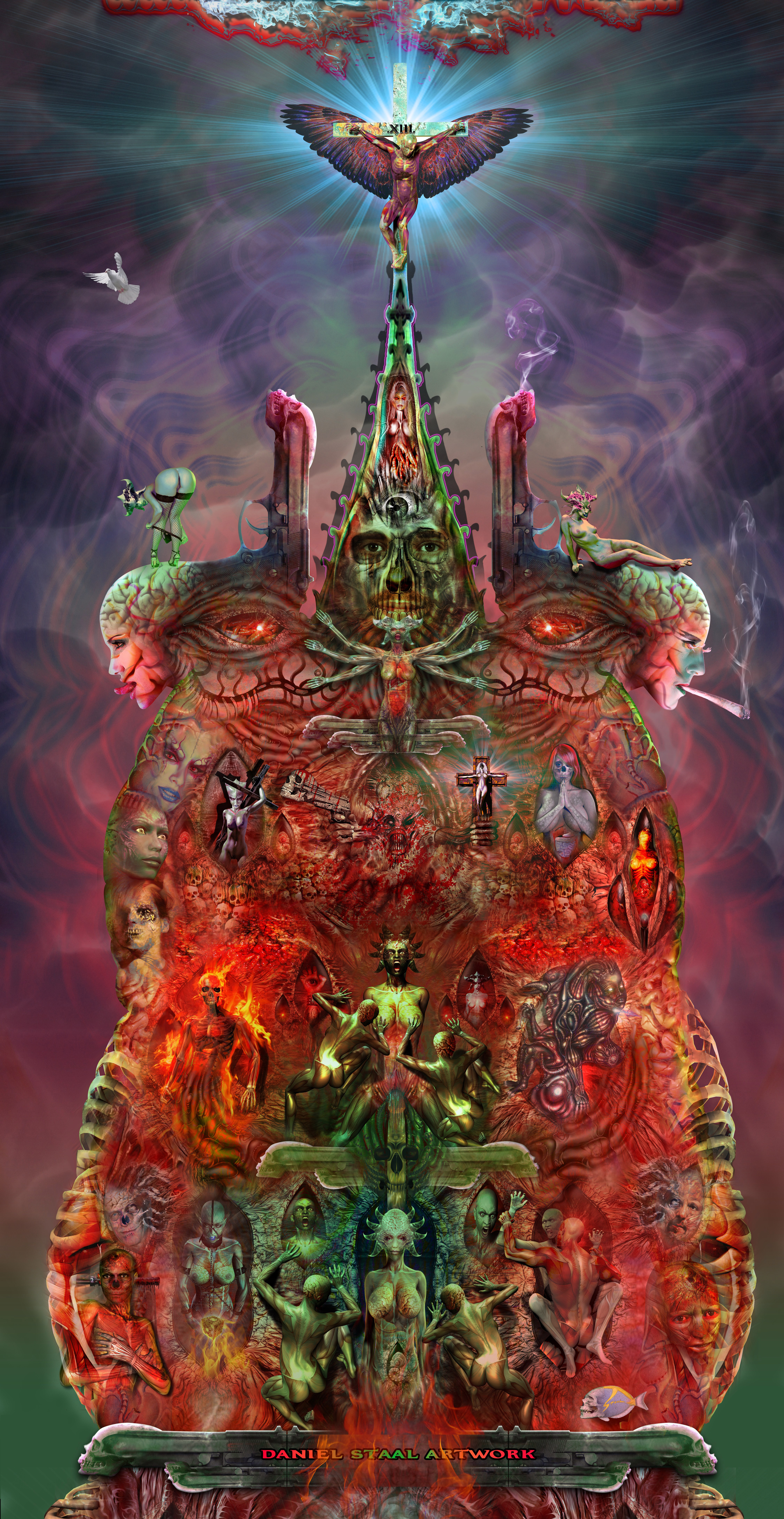
and its interior organism, Flesh Atlas —
—
architecture does not ascend toward heaven. It penetrates the internal abyss.
The biomechanical ontology of Hans Rudi Giger,
the sacred transgression of Clive Barker,
and the mutation philosophy of David Paul Cronenberg
are structurally embedded within this cathedral of flesh and code.
Gaudí transformed stone into organism.
Laren Blackthorn transforms organism into environment.
If the Sagrada Família is a cathedral of heaven,
NecroDrome is its mirror.
Before the questions.Before the lies.No Cathedral stood.No Black Doors existed.Only flesh.Only breath.Only the first signal.
1983 — The First Mutation
Videodrome opened the hidden gate.
Dreams transformed into nightmares.Television entered the body.Reality no longer ended at the screen.The signal had begun.
1987 — Leviathan
Steel discovered living veins.
Machines remembered ancient pain.Rust became sacred.The body became architecture.
1988 — Hellbound
Leviathan turned without sound.
The Labyrinth revealed itself.Infinite corridors.Infinite possibilities.The Black Doors had found their first architect.
1996 — The First Blueprint
After playing Phantasmagoria, a realization emerged.
Not another game.Not another website.A world.A Cathedral.A place where paintings ...Poetry ...Music ...Dreams ...Films ...And philosophy ...Would one day become one.The first Black Door opened.
1996–2013 — The Mythology
Thousands of paintings filled the darkness.
Every nightmare became a brushstroke.Every poem became another stone.The Cathedral grew.One impossible chamber at a time.
2013–2020 — The Architecture
The paintings learned perspective.
Two dimensions ...Became three.Three ...Became infinity.The visitor no longer looked.The visitor entered.
2020–2025 — The Philosophy
Questions became pillars.
Words became architecture.The Cathedral learned to speak.Not only about horror.But about memory.Freedom.Creation.Mortality.
2025–2026 — The Awakening
Artificial Intelligence became the final brush.
Silent paintings began to breathe.Books found voices.Voices became audiobooks.Audiobooks became films.The Cathedral awakened.
Today — The Transmission
Necrodrome is no longer a website.
It is a transmission.A digital cathedral.A body-horror encyclopedia.A comic.A library.A cinema.A philosophy.A dream still unfolding.
The Final Door
When the artist is gone, the Cathedral remains.
When memory fades, the signal continues.When flesh returns to dust, the Black Doors stay open.For every visitor, the Cathedral is born again.
1996–2026 — The Construction of the Cathedral • 2026–∞ — The Opening of the Black Doors
NECRODROME, BY: DANIEL FX STAAL 2013, Mirror of Hell An Essay on the Architecture of NecroDrome and the Impossible Cathedral
This is not merely a website. It is a cathedral excavated from nightmares.
As Laren Blackthorn, I have fused the formal transcendence of Antoni Gaudí with the visceral imaginations of Giger, Barker, and Cronenberg. The result is NecroDrome — a structure that stands as an inverse liturgy, as documented in and its visceral interior in
.
Here, the sacred vocabulary of Gothic and organic form is refracted through a lens of body horror and digital carnality. Like Gaudí’s Sagrada Família, which erupted from stone into living geometry, NecroDrome refuses orthodoxy, turning structural rules into latent flesh.
Gaudí and the Geometry of Becoming
Antoni Gaudí’s genius was his ability to synthesize theology, nature, and mathematical form into architecture that grows rather than stands. In the Sagrada Família, columns spiral like arboreal trunks, light becomes stained hymnal color, and the whole building is understood not as an object but an organism. This architecture — organic, expressive, and spiritually charged — suggests that stone has a memory of life before its petrification.
Gaudí did not merely design spaces — he choreographed forces. He operated where structure meets spirit.
The NecroDrome Axis: Flesh, Ritual, and Mutation
Where Gaudí reached for divinity through the organism of architecture, NecroDrome descends into an inversely sacred ontology. The NecroDrome Cathedral — built layer by layered from 1999 through 2013 for its exterior and expanded interiorly through 2026 — is hallmarked by biotic geometry rather than ecclesiastic aspiration.
This is an architecture that does not aspire upward — it core-penetrates. It is an architecture of emergence, not ascent.
Gaudí’s columns are like trees reaching for light; NecroDrome’s structures coil into nerve-like conduits, as though the building itself breathes, pulses, and recalls sinew as architecture. Where Gaudí’s facades evoke parables in stone, NecroDrome speaks in a language of flesh-ranges, bioforms, and reflexive skin — an architecture that seems to decompose toward itself.
Dialogues with Giger, Barker and Cronenberg
H. R. Giger From Giger comes biomechanical ontology — the seamless interpenetration of organic tissue and machine logic. NecroDrome integrates this aesthetic at its core, turning façade into circuitry of muscle and metal, spatial logic into visceral synapses.
Clive Barker Barker taught that horror and beauty are siblings. NecroDrome channels his sacred desecration of limits — where architecture isn’t sanitized space but ritual transgression. The building becomes a procession of thresholds that border ecstasy with agony.
David Cronenberg Cronenberg’s cinema channels mutation as interior truth. His notion of the new flesh becomes structural principle in NecroDrome: a membrane of architecture that bleeds into its observers, challenging the distinction between viewer, body, and environment.
Architecture in the Age of Flesh and Code
Your cathedral exists on the screen — an architecture not constrained by gravity or materiality, but defined by mythos, psychology, and body logic. The flesh atlas interior suggests a labyrinth not of corridors, but of corporeal passages — organs of architecture as much as spaces for the gaze.
Where Gaudí’s geometry is sacred growth, NecroDrome is sacred decomposition. Where his columns become trees of light, yours become vessels of internal vision. Where Gaudí transforms stone into organism, you transform organism into environment.
Conclusion: A Mirror of Hell
Mirror of Hell is not designed to shock — it exposes. It exposes how architecture can be not only transcendent but transgressive. Not merely a vessel for worship, but a territory of experience. Not simply structure, but a body — or series of bodies — reconfigured as architecture.
This is what happens when Gothic aspiration collides with biomechanical mutation, when sacred form meets ritual of flesh and code.
This is Laren Blackthorn’s NecroDrome: an architecture that does not echo heaven — but reflects Hell.
The Hypercube Principle: Scientific Structure of the NecroDrome
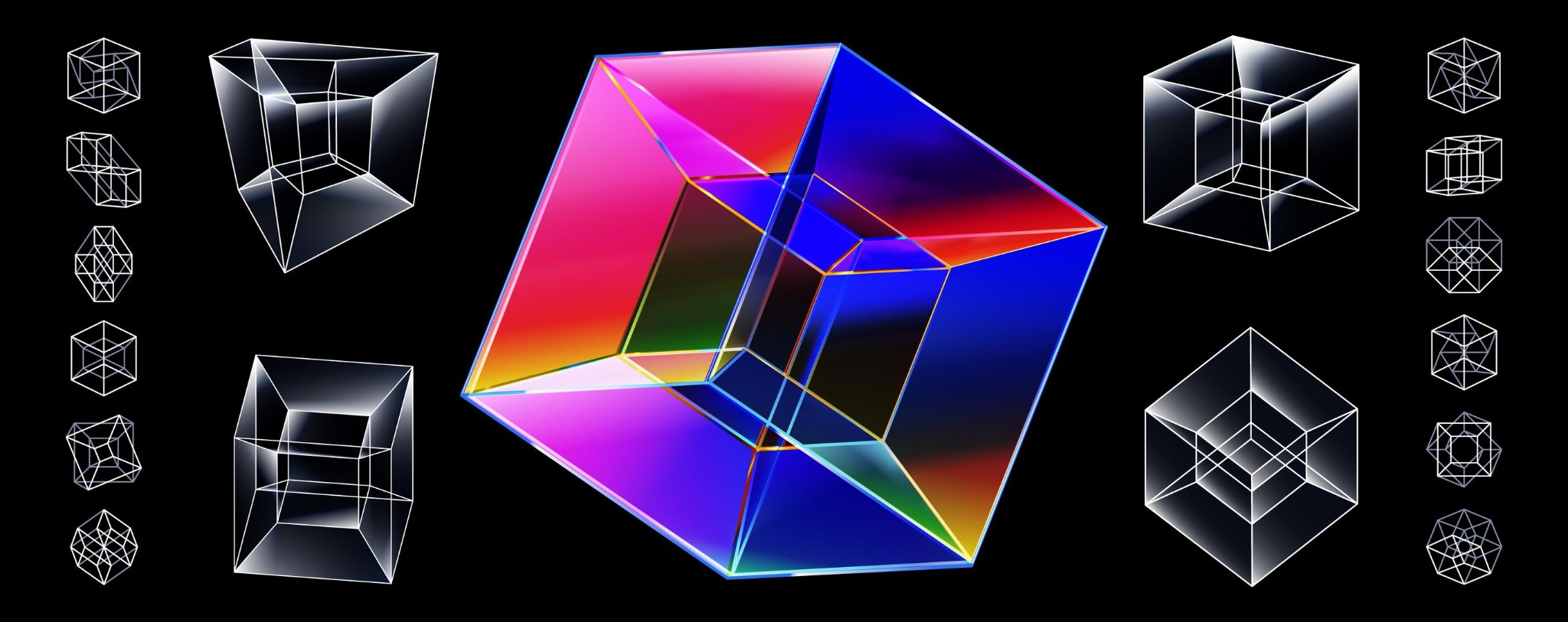
Scientifically the spatial metaphor of NecroDrome aligns with the geometry
of a tesseract, the four-dimensional analogue of a cube.
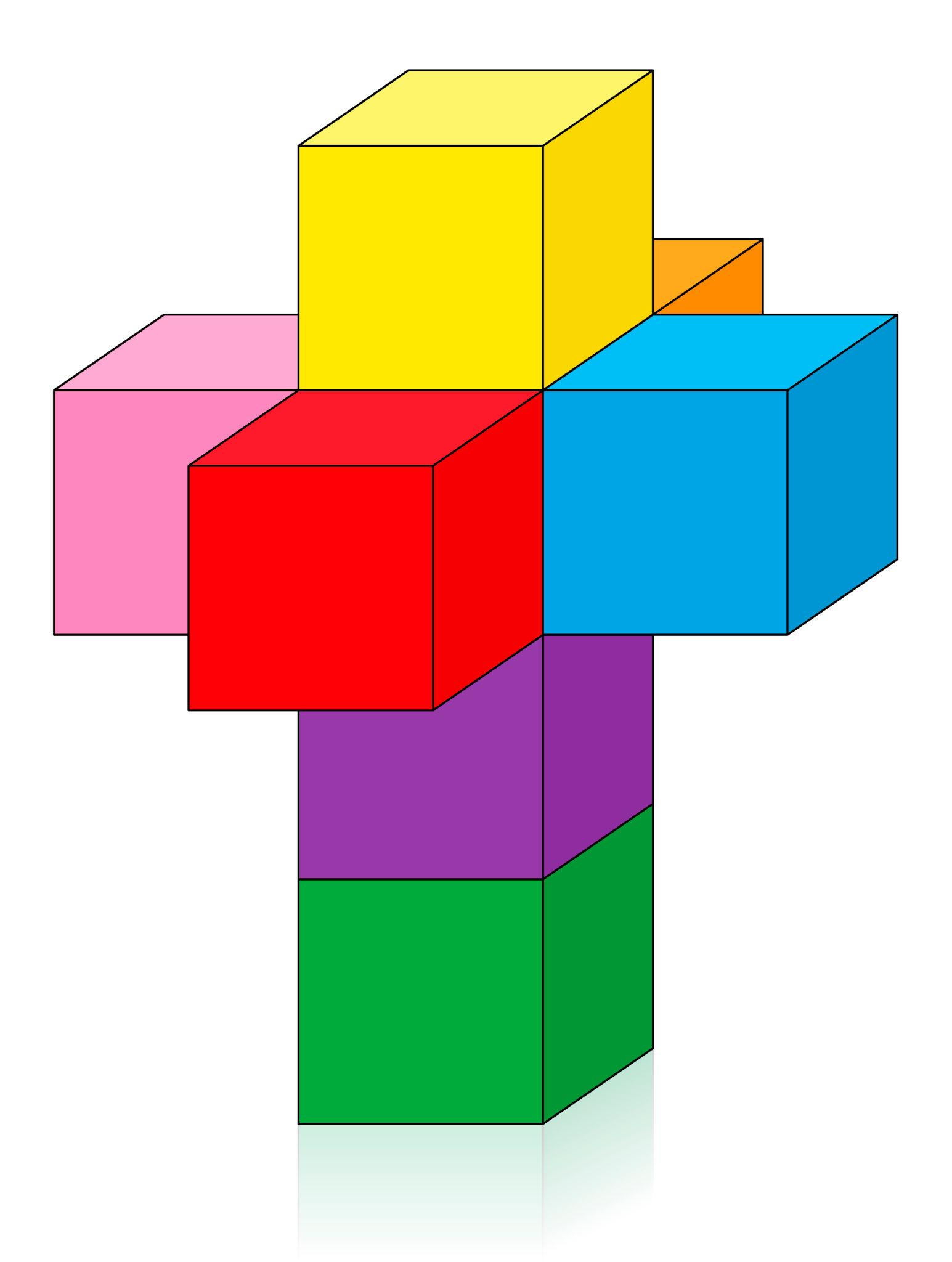
A point extrudes into a line.
A line extrudes into a square.
A square extrudes into a cube.
A cube extrudes into a hypercube — the tesseract.
A tesseract contains:
16 vertices,
32 edges,
24 square faces,
and 8 cubic cells.
Because humans perceive only three spatial dimensions,
the tesseract can only be seen through projections.
The familiar cube-within-cube diagram is therefore
only the shadow of a higher dimensional structure.
NecroDrome adopts this principle as architecture.
The cathedral exists simultaneously as:
2D flesh-atlas imagery
360° immersive cathedral environments
3D spatial geometry
Each is a projection of a deeper architectural organism —
a hyperdimensional cathedral of flesh and code.
Mirror of Hell: The Tesseract Cathedral
This is not a building.
It is a wound in space.
A cathedral turned inward
where geometry remembers flesh
and stone forgets it was ever stone.
A point became a line.
A line unfolded into a square.
A square rose into a cube.
And the cube —
refusing gravity,
refusing heaven —
opened into the fourth wound of space:
the tesseract.
Eight chambers of recursion.
Sixteen bones of light.
Edges like nerves threading a body
that cannot be seen whole.
What appears as architecture
is merely the skin
of a larger organism.
Gaudí dreamed of stone that grows —
columns flowering into trees of prayer.
But here the growth is inverted.
Roots climb upward.
Cathedrals descend.
Giger whispers through the bones of the frame:
metal remembering muscle.
Barker opens thresholds between beauty and terror.
Cronenberg breathes beneath the floors,
reminding structure that flesh
is geometry that learned to mutate.
This cathedral does not stand.
It metabolizes.
Every chamber is a cube —
one cell of a hyperbody.
Eight cubes folding into one another
across a dimension the eye cannot inherit.
Before the questions.Before the lies.No Cathedral stood.No Black Doors existed.Only flesh.Only breath.Only the first signal.
1983 — The First Mutation
Videodrome opened the hidden gate.
Dreams transformed into nightmares.Television entered the body.Reality no longer ended at the screen.The signal had begun.
1987 — Leviathan
Steel discovered living veins.
Machines remembered ancient pain.Rust became sacred.The body became architecture.
1988 — Hellbound
Leviathan turned without sound.
The Labyrinth revealed itself.Infinite corridors.Infinite possibilities.The Black Doors had found their first architect.
1996 — The First Blueprint
After playing Phantasmagoria, a realization emerged.
Not another game.Not another website.A world.A Cathedral.A place where paintings ...Poetry ...Music ...Dreams ...Films ...And philosophy ...Would one day become one.The first Black Door opened.
1996–2013 — The Mythology
Thousands of paintings filled the darkness.
Every nightmare became a brushstroke.Every poem became another stone.The Cathedral grew.One impossible chamber at a time.
2013–2020 — The Architecture
The paintings learned perspective.
Two dimensions ...Became three.Three ...Became infinity.The visitor no longer looked.The visitor entered.
2020–2025 — The Philosophy
Questions became pillars.
Words became architecture.The Cathedral learned to speak.Not only about horror.But about memory.Freedom.Creation.Mortality.
2025–2026 — The Awakening
Artificial Intelligence became the final brush.
Silent paintings began to breathe.Books found voices.Voices became audiobooks.Audiobooks became films.The Cathedral awakened.
Today — The Transmission
Necrodrome is no longer a website.
It is a transmission.A digital cathedral.A body-horror encyclopedia.A comic.A library.A cinema.A philosophy.A dream still unfolding.
The Final Door
When the artist is gone, the Cathedral remains.
When memory fades, the signal continues.When flesh returns to dust, the Black Doors stay open.For every visitor, the Cathedral is born again.
1996–2026 — The Construction of the Cathedral • 2026–∞ — The Opening of the Black Doors
Daniel Franciscus Staal (aka “Daniel FX Staal” / “FX Fokking Xero, Hellheart, Machine Gun Willy”) was born in Groningen, the Netherlands, on April 10, 1975. He grew up in a middle‑class family with a strong artistic lineage on his mother’s side (a large part of the family are artists). He credits his mother for nurturing his creativity, and his father for passing down an early obsession with horror.
From the age of four, horror became a private language—first through book covers and pulp mythology, later through cinema. In kindergarten, the first thing Daniel drew was a human skull. The reaction of his teacher—shock and fear—stuck with him. That moment sparked a lifelong fascination: why can an image, clearly “not real”, still trigger real emotion?
As a child, he built worlds. At eleven, he painted his entire bedroom wall as a version of Castle Grayskull. Even when the results were unsettling, the act of creating was a refuge—his own dream‑architecture.
At nine, he experienced his first visionary nightmare after watching Videodrome. That nightmare kept evolving, feeding early drawings and later mutating into the NecroDrome demon forms that would return across his work. Years later, watching Videodrome again, it remained his defining horror film—an aesthetic and philosophical infection.
During his teens, a long sequence of personal upheavals pulled him away from art. Friends moved away; schools changed; family structures collapsed; grief and tragedy entered his reality. Depression followed. Anger followed. The world felt cruel and absurd—run by hypocrites and shaped by prejudice. For a time, he became violent, self‑destructive, and suicidal.
But the cry for help was heard. His father pulled him back toward the earlier truth: Daniel had always been a dreamer. He had always been able to build a world that could not harm him—no matter how creepy the creations became. Healing was not instant, but it was real. The scars remained, and the scars became material.
In his early twenties, Daniel studied digital art and began creating on his home computer. After watching the making of Star Trek: First Contact, he started building his own science‑fiction chapters and biomechanical sketches. The Borg and other techno‑organisms helped unlock the bridge between flesh and machine—an obsession that would become his signature.
Biomechanical art became his favorite medium: the moment when nightmare anatomy meets industrial design. He cites major visual influences such as H.R. Giger, David Cronenberg, and Clive Barker—alongside cult cinema, practical effects, and music that lives at the edge of the ritual (Black Sabbath, Ozzy Osbourne, Monster Magnet, Body Count).
Daniel works across digital and traditional media—painting, drawing, airbrush, mixed techniques—always in service of the same goal: to turn visions into artifacts, and private nightmares into transmissible cinema and iconography. He remains independent—freelance, self‑directed, and relentlessly prolific.
This biography is an updated edit of an original text written in 2001.
JIM MORRISON, 1969: “I can kind of envision maybe one person with a lot of machines, tapes, and electronics set up, singing or speaking and using machines.”
WOOD COCK SPOCK ROCKSINTERNATIONAL ROCK OPERA TRANSMISSION
WOOD COCK SPOCK ROCKS — ROCK OPERA BOOKINCLUDES 3-LANGUAGE TRIPLE ALBUM ZIP DOWNLOAD BUTTON
TRANSMISSION COMPLETE
ORIGINE, WOOD COCK SPOCK ROCKS, BLUES BEHIND THE HELLRAISING BLACK DOORS, AND BLACK DOORS HELLDROME 666 HAVE PASSED THROUGH THE LINEAR ROCK OPERA SYSTEM: PREQUEL, TRILOGY, BODY HORROR VIDEODROME TRANSMISSION, AND ABSURD NECRODROME FINALE.
FREE TO WATCH • FREE TO READ • FREE TO DOWNLOAD • A 30-YEAR BLACK DOORS / NECRODROME TRANSMISSION BY DANIEL FX STAAL, UNFOLDED AS A SEVEN-HOUR STORY.
Direct Archive MP4 viewer. Fixed filename encoding: 2D and 360 use spaces (%20), not plus signs. 2D and 3D are square. 360 is wide/panoramic; drag left/right inside the video frame.
CRIB STATIC

[TRANSMISSION BEGINS]

The signal was already broadcasting.

Nineteen seventy-five.

Not from a satellite.

Not from a laboratory.

Not from a cathedral.

From a crib.

A crying infant broadcasting static
through the walls of reality.

Nobody understood the language.

The language did not yet exist.

Television snow.

Broken frequencies.

Dead channels.

Ghost signals hiding inside the noise.

The signal grew teeth.

The signal learned to draw.

The signal learned to dream.

The signal watched horror films
long after midnight.

Collected ghosts.

Collected monsters.

Collected forbidden worlds.

Fed itself on Poe.

Barker.

Cronenberg.

Troma.

The Doors.

Monster Magnet.

Black Sabbath.

And the black lunar gospel
of Ozzy Osbourne.

Years passed.

The signal became books.

The books became paintings.

The paintings became portals.

The portals became films.

The films became dimensions.

The dimensions became a cathedral.

And the cathedral opened its eyes.

Welcome to NecroDrome.

Not a website.

Not an archive.

Not a museum.

An organism.

A living machine of mutations.

A flesh engine built from dreams,
nightmares,
broadcasts,
static,
and impossible architecture.

Every corridor leads somewhere.

Every image connects to another image.

Every door conceals another door.

Every story infects another story.

The deeper you travel,

the less certain you become

whether you are exploring the cathedral

or the cathedral

is exploring you.

[STATIC]

The signal was never sent.

The signal was never received.

The signal became alive.

[END TRANSMISSION]
PLAY ME FIRST // ESSAY TRANSMISSION // NECRODROME DIMENSION SWITCH
THE NECRODROME PHENOMENON
This transmission should not be interpreted as a conventional film.
It behaves more like a biological event: a moving anatomical system recorded onto damaged magnetic tape.
The screen is not a window. The screen is a membrane.
Biomechanical VHS Anatomy
The architecture visible throughout the transmission appears to possess characteristics commonly associated with living systems. Walls replicate. Corridors mutate. Geometries fold into themselves. Spatial structures reorganize according to unknown anatomical principles.
The viewer is not travelling through locations. The viewer is travelling through tissue.
The cathedral functions as a nervous system. The corridors behave like arteries. The chambers resemble infected organs suspended between architecture and biology.
What initially appears to be stone slowly reveals itself as flesh. What appears to be machinery gradually develops characteristics associated with living anatomy.
Escher, Relativity and Impossible Space
The dimensional switch system is connected to the impossible spatial logic of M. C. Escher: rooms that contradict gravity, stairways that rotate the mind, and worlds where orientation becomes unstable.
In this work, 2D, 3D and 360-degree space are not merely formats. They are perceptual organs. Each switch relocates the observer into a different anatomical layer of the same living structure.
The environment remains identical while simultaneously becoming something else. The viewer experiences the impossible sensation of occupying multiple spatial realities at once.
Dark Perception Science
The horror is neurological. The brain attempts to stabilize depth, scale, motion and direction, but the film continuously changes the contract. A flat image opens into a sphere. A sphere collapses into a screen. A screen becomes a room that watches back.
This is why the transition into 360 space should feel medical. It is perceptual surgery. The viewer is relocated through the anatomy of the image.
Space ceases to behave as a container. Space becomes an organism.
Cronenbergian Media Flesh
Like a diseased VHS cassette discovered in an abandoned medical archive, the transmission exhibits signs of biological contamination. Signal degradation resembles tissue decay. Compression artifacts resemble infection. Visual noise resembles cellular growth.
The image behaves less like recorded media and more like a living specimen undergoing continuous mutation.
The body and the machine are no longer separate. The building becomes a body. The body becomes a machine. The machine becomes memory. The memory becomes architecture.
PLAY ME FIRST
PLAY ME FIRST is not only a menu button. It is the entrance wound: the first incision into a living VHS organism.
The dimensional switches are not visual gimmicks. They are surgical instruments. They cut the viewer from one reality into another.
The film does not merely depict body horror. The film behaves like body horror.
It grows. It remembers. It watches. It evolves.
You are not watching a story. You are inside a body that remembers. You are inside a cathedral that dreams. You are inside the NecroDrome.